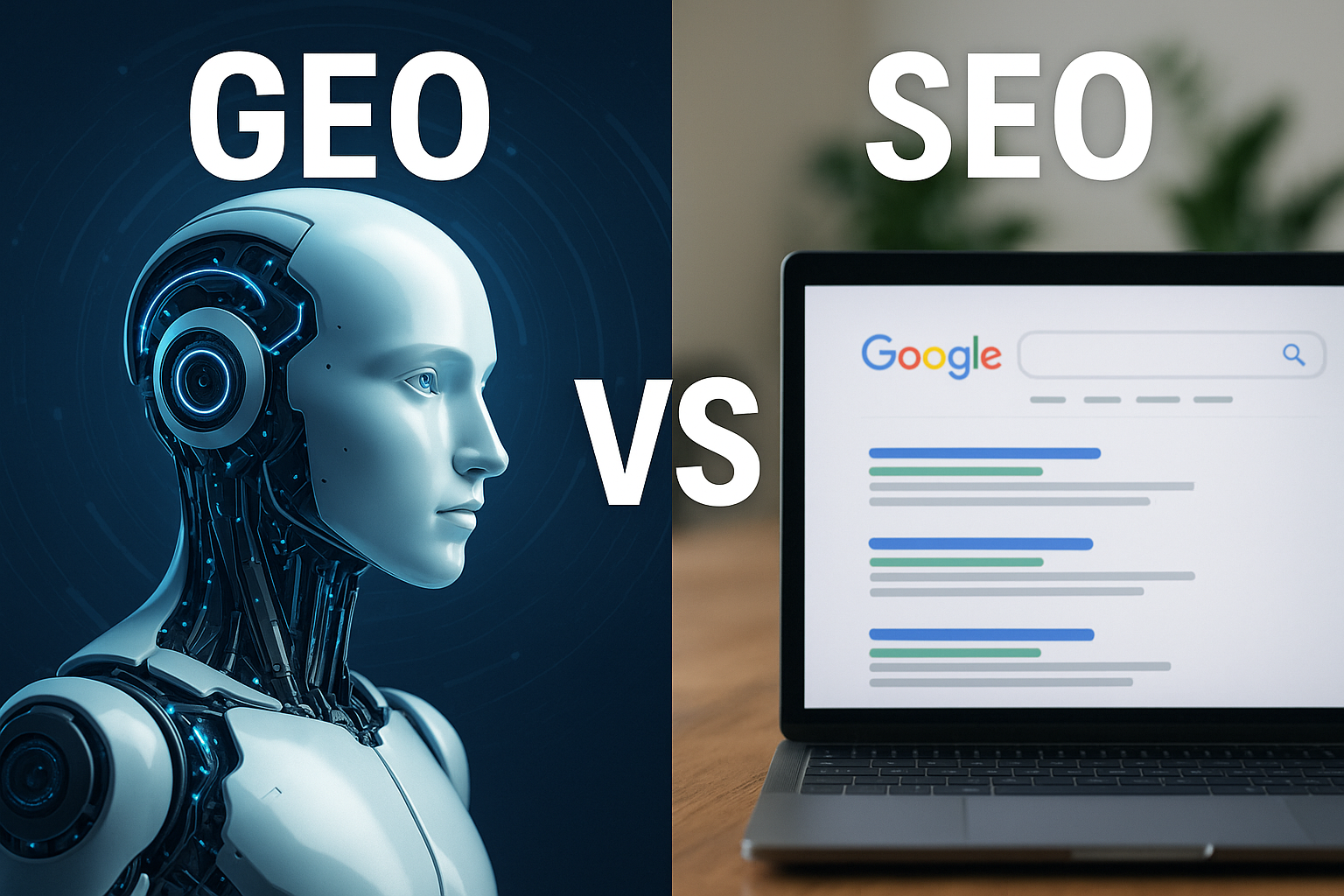
We’ve entered a new era of search.
Where traditional search engines once ruled, artificial intelligence is now reshaping how we find information and how brands are discovered. If you’re still only optimising for Google’s blue links, you’re missing half the game. Enter GEO: Generative Engine Optimisation. It’s not just a buzzword; it’s the new frontier.
But how does GEO differ from SEO? Why should you care right now? And more importantly, how do you make sure your content stands out in both the old world of search and the new?
Let’s break it down.
What Is SEO (Search Engine Optimisation)?
Let’s start with the familiar.
SEO, or Search Engine Optimisation, is the art and science of improving your website’s visibility on traditional search engines like Google, Bing, and Yahoo. It's about making your site discoverable when users search for relevant keywords. Think of it as your digital storefront’s location on the internet’s main street.
The SEO Toolbox
SEO is a well-worn field, but it’s still critical. Here's what SEO focuses on:
1. Keyword Optimisation
Researching and strategically placing keywords and phrases that your audience is searching for.
2. Content Quality
Crafting informative, well-structured content that’s valuable to both users and search engines.
3. Backlinks
Building links from reputable sites that vouch for your content’s authority.
4. Technical SEO
Enhancing your site’s backend, like improving load speed, mobile responsiveness, and making sure Google’s bots can crawl your pages.
Why SEO Still Matters
Despite AI’s rise, SEO is far from obsolete. Ranking well in traditional search results still means more clicks, more eyeballs, and more trust. A well-optimised SEO strategy continues to drive traffic, especially for research-driven or product-focused queries.
But here’s the twist: The search results page is no longer the only place people get answers.
What Is GEO (Generative Engine Optimisation)?
Enter GEO, Generative Engine Optimisation. While SEO is about ranking on lists, GEO is about being in the answer.
Generative engines like ChatGPT, Google SGE (Search Generative Experience), Perplexity, Bing Copilot, and others don’t just give users a list of links. They generate direct answers using content pulled from across the web. If your content is included in that synthesised response, congrats, you just won a GEO moment.
But if not? You might not even get noticed.
The GEO Toolbox
GEO is about making your content AI-friendly so that it gets pulled into generated answers. That requires a different set of tools:
1. Clarity & Structure
Use clear headings, bullet points, lists, and concise answers. AI needs clean, scannable content to extract from.
2. Factual Authority
Your content needs to be trustworthy, well-cited, and verifiable. AI prioritises authoritative sources.
3. Formatting for AI
Use structured data (think schema markup), clear summaries, and FAQ sections to help models “understand” your content.
4. Citation Readiness
Make sure your brand and website name are clearly associated with your content. If AI references your info, it may cite or link back to you directly.
Why GEO Is Gaining Traction Fast
Let’s face it, people love direct answers. AI gives them that. Instead of reading five blog posts, users get a paragraph-long summary.
GEO helps your content become that answer.
And with millions using generative AI platforms every day, GEO isn’t just nice to have; it’s becoming essential.
SEO vs GEO: A Side-by-Side Comparison
Let’s get clearer on how these two strategies compare.
SEO and GEO serve different purposes, but both help businesses improve their online visibility. SEO focuses on helping websites rank in search engine results, while GEO focuses on making content easier for generative AI platforms to understand, reference and include in AI-generated answers.
SEO and GEO serve different purposes, but both help businesses improve their online visibility. SEO focuses on helping websites rank in search engine results, while GEO focuses on making content easier for generative AI platforms to understand, reference and include in AI-generated answers.
1. Target Platforms
SEO: Focuses on traditional search engines such as Google and Bing, helping users discover relevant websites through search results.
GEO: Focuses on generative AI platforms such as ChatGPT and Perplexity, where users receive conversational answers based on information from various sources.
2. User Experience
SEO: Users typically see a list of search results and click on relevant links to explore information.
GEO: Users receive a synthesised response that brings together information from multiple sources, sometimes with citations and links.
3. Optimisation Focus
SEO:Emphasises keyword research, search intent, technical website performance, backlinks, content quality and internal linking.
GEO: Emphasises clear content structure, factual accuracy, authoritative sources, contextual relevance and information that AI systems can interpret and reference.
4. Primary Goal
SEO: Aims to improve search rankings, attract relevant organic traffic and encourage users to visit your website.
GEO:Aims to improve the likelihood that your brand, expertise or content will be mentioned, represented accurately or cited in AI-generated responses.
5. Key Performance Metrics
SEO:Performance is commonly measured through keyword rankings, organic traffic, click-through rate, conversions and engagement metrics.
GEO:Performance can be assessed through brand mentions in AI responses, citation frequency, source visibility, answer accuracy and referral traffic from AI platforms.
6. Content Style
SEO:Content should address search intent comprehensively, use relevant terminology naturally and provide useful information for readers.
GEO: Content should present information clearly, answer questions directly, use descriptive headings and support important claims with credible evidence.
7. Updates and Adaptation
SEO:Requires ongoing adaptation to search engine algorithm changes, evolving user behaviour, technical requirements and competitor activity.
GEO: Requires ongoing monitoring as AI models, retrieval systems, source selection and answer-generation behaviour evolve.
Can SEO and GEO Work Together?
Absolutely. SEO and GEO are complementary strategies rather than competing approaches. A technically sound website with helpful content, credible references and clear information can support both traditional search visibility and discovery through AI-powered platforms.
Businesses should build a strong SEO foundation while adapting their content to answer questions clearly and establish credibility across the sources that AI systems may use.
The goal is not simply to rank in search results or appear in AI answers. It is to help the right audience discover your business and find reliable information about your brand, wherever they search.
Why GEO Matters Right Now
1. AI Search Is Surging
Generative AI tools are fast becoming a primary search method. Tools like ChatGPT and Google SGE are redefining how users access information. Instead of browsing multiple websites, users get one curated answer.
If your content isn't optimised for that space, you're out of the conversation.
2. Organic Traffic Is Under Threat
AI-generated answers often reduce the need for users to click through to websites. Recent studies show publishers could lose 15–40% of organic traffic as AI-driven answers dominate the top of the search funnel.
You could rank #1 on Google, and still be invisible to users using AI tools.
3. The Rise of Zero-Click Search
We’re entering a zero-click world, where AI search tools provide everything users need, right on the spot. GEO is about making sure your content is part of those answers.
That means being one of the few sources cited. The competition is fierce, and the reward is high.
4. The Early Bird Gets the Brand Equity
GEO is still new terrain. Early adopters who structure their content correctly are getting more brand exposure in AI answers, earning authority, awareness, and trust in the process.
Do You Really Need Both?
Yes. Unequivocally, absolutely yes.
You can’t choose between SEO and GEO. You need both.
SEO is still the backbone; it brings consistent traffic, builds domain authority, and supports long-form content. But GEO is your bridge to the future; it’s how your brand shows up in the emerging AI search experience.
Together, they form a comprehensive search strategy that future-proofs your visibility.
The Core Mindset Shift
With SEO, you're thinking:
“How do I rank on Google when someone searches for a keyword?”
With GEO, you’re asking:
“How do I become part of the AI’s answer when someone asks a question?”
Different questions. Different strategies. But they must work together.
In short, SEO helps users find you. GEO helps AI find and use you.
How to Optimize Content for GEO (Generative Engine Optimization)
If SEO is about pleasing search engine crawlers, GEO is about making your content easily digestible for AI models, those that synthesise, summarise, and respond.
Here’s how to help your content get used in answers, not just found in links.
1. Structure Your Content Like an Answer Sheet
Generative AI loves structured, digestible content.
- Use headers (H2, H3, H4) wisely: Break down information into scannable sections.
- Lists & bullet points: Perfect for step-by-step processes, key takeaways, and definitions.
- FAQs & summaries: Add dedicated sections that answer common questions directly and succinctly. AI pulls from these readily.
- Concise intros: Kick off articles with clear summaries of what’s covered. Think of it like your content's “TL;DR.”
Pro Tip: Use question-based headings. For example, instead of “GEO Benefits,” try “What Are the Benefits of GEO?”, mirroring the way users query generative AI tools.
2. Prioritise Factual, Verifiable Information
AI engines prefer authoritative and factual content because it helps reduce hallucinations (false or fabricated data).
- Cite credible sources in your content.
- Include stats, numbers, and quotes with context.
- Clearly distinguish between fact and opinion.
Pro Tip: Add schema markup (e.g., FAQ, How-To, Article) to make your content even easier for AI to interpret.